- Tiny Farm Friends
- Posts
- The air that taught me to pause
The air that taught me to pause
Tiny Insights for building naturally, building beautifully.
No.116 — Read old posts on Tinyfarmlab.com
Reading Time 5 minutes
Somewhere on the highway,
without warning,
the colour of the air thickened.
The smell arrived first.
Sharp.
Dense.
Chalky.
Almost metallic.
Someone in the car joked, dark humour as instinct:
“Is this another gas tragedy?”
We laughed.
Nervously.
I was travelling with my client towards Bandhavgarh, via Katni in Madhya Pradesh. A familiar route on a map. An unfamiliar feeling in the body.
And then we saw the chimneys.
That’s when we realised we had entered Jhukehi, Katni.
Rows and rows of lime kilns.
White dust is settling everywhere,
on trees, on skin,
and maybe on lungs.
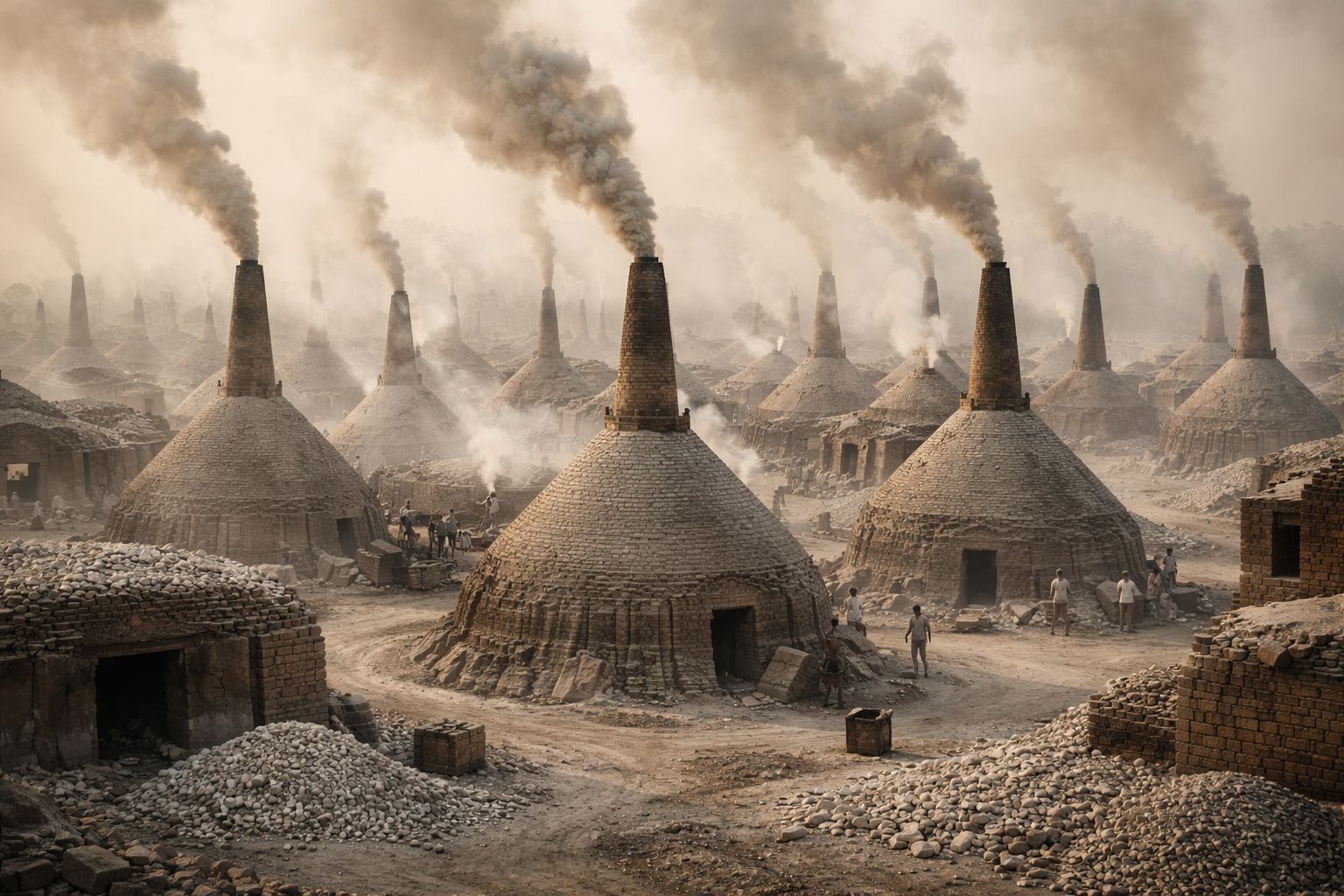
AI Generated
Workers moved like ghosts,
covered head to toe in white soot,
as if the landscape itself was slowly bleaching them out.
I have not been able to shake that image.
Because for years now,
I have spoken about lime as an alternative.
A better material.
A breathable one.
Kinder than cement.
Often carbon-neutral,
sometimes even carbon-negative.
All of that is still true.
But standing there,
eyes burning,
throat tightening,
unable to bear the smell,
truth became complicated.
The problem I encountered in Katni wasn’t lime itself.
It was centralisation.
When any material,
no matter how benign,
gets industrialised, concentrated, and A
scaled without care,
it stops being innocent.
Yes, lime kilns are not asbestos factories.
Yes, they are far less toxic than cement plants.
Yes, many kiln owners told us with pride
that no one here has lung disease.
That they have been working for generations.
That they eat gud (jaggery) every day to counter the dust.
That their fathers did the same.
Some reports agree with them.
Others don’t.
What research does show is this:
Lime dust is alkaline,
not carcinogenic like asbestos.
It does not lodge permanently in the lungs the way silica from cement does.
Open kilns, ventilation,
and traditional diets may reduce long-term damage.But reduce does not mean negate.
And centralised lime production still means:
– Localised air pollution
– Ecological stress on one geography
– Entire towns breathing what cities outsource
Economies of scale may work for balance sheets.
They rarely work for landscapes.
So why choose lime over cement?
Because despite everything I saw,
lime remains the lesser evil.
And more importantly,
it offers us a way out,
if we use it wisely.
To understand this,
we need to look briefly at how both materials come into existence.
CEMENT: A ONE-WAY JOURNEY
Manufacturing
Cement is made by heating limestone and clay
to about 1450°C in massive rotary kilns.
This process does two things simultaneously:
Burns fossil fuels at extremely high temperatures
Chemically releases CO₂ locked inside limestone
For every tonne of cement produced,
nearly one tonne of CO₂ is released.
This carbon is never reabsorbed.
Usage
Once cement sets,
it becomes dense,
impermeable, and rigid.
Buildings trap moisture,
crack under thermal stress,
and age poorly without chemical repairs.
At the end of its life,
cement rubble remains inert waste.
Cement is a linear material:
extract → burn → build → discard.
LIME: AN IMPERFECT CIRCLE
Manufacturing
Lime is produced by heating limestone at much lower temperatures—
around 800–1000°C.
Yes, CO₂ is released during burning.
This is the part we often gloss over.
But here’s the difference.
Usage and Afterlife
When lime is used in mortar or plaster,
it slowly reabsorbs CO₂ from the atmosphere
through a process called carbonation.
Over years, sometimes decades,
it turns back into limestone.
This is why old lime buildings can be dismantled
and their material reused.
Why lime mortars remain repairable.
Why walls breathe instead of suffocating.
Lime is not perfectly carbon-neutral in practice,
especially when industrialised,
but it is carbon-cycling.
And that matters.
Lime allows buildings to breathe.
Moisture moves.
Mould reduces.
Interiors age gently instead of violently.
But Katni reminded me that breathability
must apply beyond architecture.
Materials must breathe geographically.
Production must breathe socially.
Landscapes must breathe ecologically.
Historically, lime was local.
Burnt close to where stone was quarried.
Used sparingly.
Allowed to mature slowly.
The real question is not lime vs cement
It is how much.
Where.
And for whom.
Breathable doesn’t mean limitless.
Natural doesn’t mean infinite.
Better doesn’t mean unquestionable.
We don’t need to abandon lime.
But we do need to return to it with restraint.
Decentralised production.
Contextual use.
Slower construction.
Materials that participate in ecosystems,
not dominate them.
The air in Katni taught me this before any report could.
The air doesn’t lie.
It carries the cost long before data does.
Love and light,
Raghav and Ansh
P.S.: If you are on LinkedIn, let’s connect!
What you can watch -
What you can listen to -
If you found value in this newsletter, please consider sharing it with a friend.
Tiny Farm Friends Newsletter.
Every Sunday, we share tiny valuable lessons to help you transition to the countryside and build naturally.